A report on the latest CABMM Scientific Seminar mini-series

Over three lunchtimes in May, long-standing CABMM member, Prof. Markus Loibl from Schulthess Klinik in Zurich, organized an online lecture series on current topics in the field of spinal disorders. The lecture series, Contemporary Topics in Degenerative Spine Disease: Modic Changes, Cervical Compensation and Automated Imaging, consisted of three consecutive presentations analyzing different aspects of degenerative spine disease.
- Dr. Gregor Fischer: Recurrent Disc Herniations and the Clinical Implications of Modic Changes
- Dr. Marco Manzetti: Degeneration and Compensatory Mechanisms of the Cervical Spine
- Dr. Andrea Cina: AI and Automated Image Analysis of the Spine
Prof Loibl also paid tribute to CABMM member, Prof Stefan Dudli, for his original work on Modic changes, out of which the Schulthess Klinik created a clinically meaningful study which formed part of Dr Gregor Fischer’s presentation.
Dr Fischer covered the topics of Modic changes and recurrent lumbar disc herniation, first providing some general perspectives on lumbar disc herniation to set the scene. Having presented the findings of the Modic changes study, he advocated for personalized medicine saying, “In the end, it's important to propose a risk-stratified approach. It's not a one-size-fits-it-all. You should make the decision (to operate) based on radiological and clinical parameters, such as BMI, disc degeneration and Modic changes.”
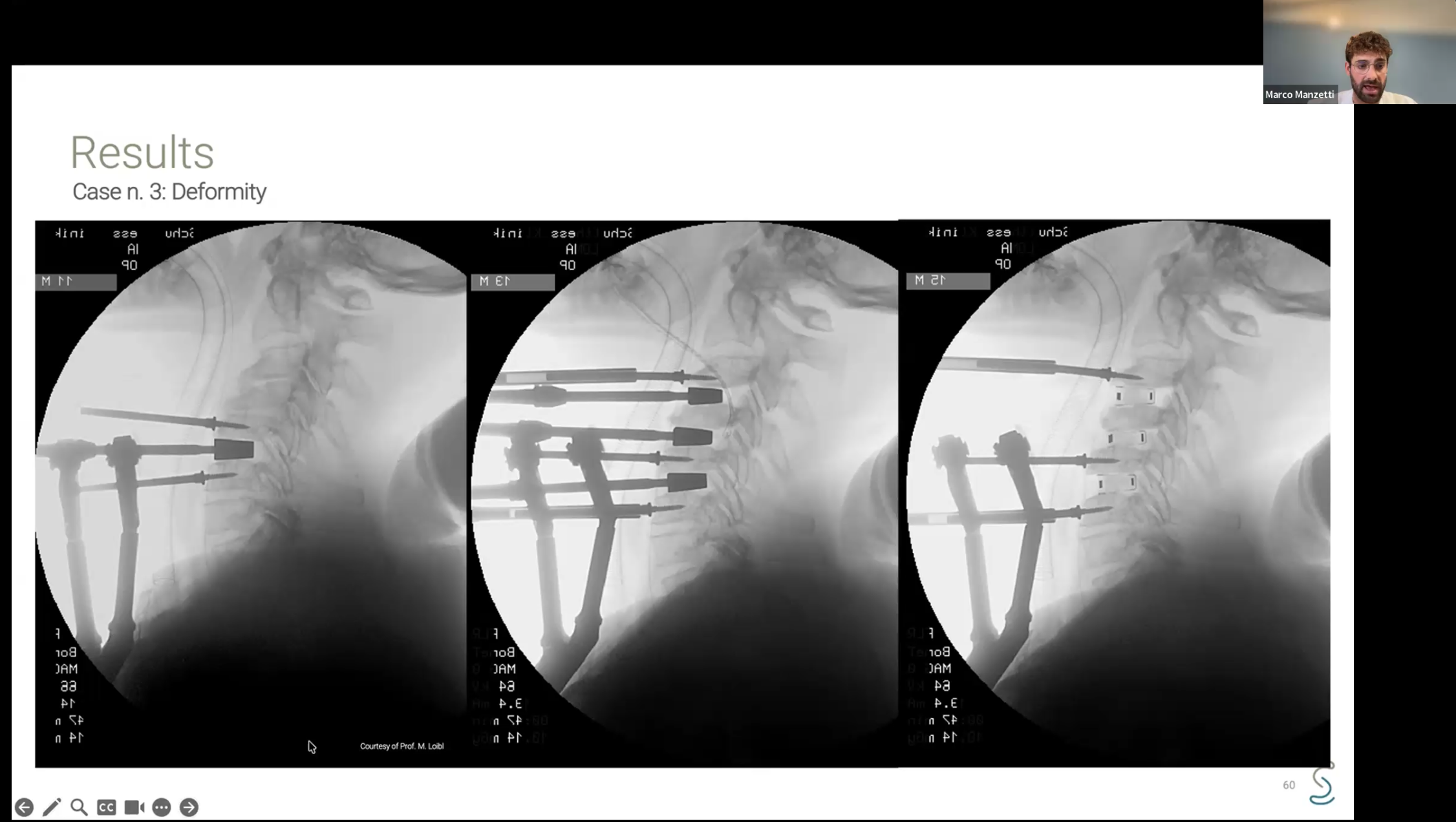
A week later, Dr Marco Manzetti expertly explained cervical spine degeneration and the compensatory mechanisms that it may trigger. He also presented the results of a study conducted in Schulthess Klinik to analyze the cervical-sagittal alignment before and after surgery, and to identify possible compensatory mechanisms and the postoperative change. Dr Manzetti also spoke of the importance of patient-reported outcome measures and patient education. “To me, a good education of the patient is a key for good outcomes, for expectations and results.”


The final presentation was slightly different from the two others as it was given by Dr Andrea Cina, a data scientist. He gave the audience a brief introduction to machine learning and illustrated the benefits of running studies in this way. “Imagine if you want to run a study on, for example, spinal alignment. Someone has to annotate the images, compute the parameters and then you can run your analysis. But this process is always time-consuming, and it is also subject to human errors. So, in this case, a deep learning model will enable a faster, reproducible study, because the model, once it’s trained, it’s trained, and it’s fixed, which means that it’s very consistent in what it gives. And it’s scalable, which means that you can use the same model to process 1,000 or 10,000 images.”
Prof Loibl noted the value of the CABMM Scientific Seminar mini-series, saying, “It's really important for us. As Schulthess Klinik, we want to create visibility for basic science projects.” Prof Loibl ended the series with a plea for anyone connected to CABMM who is working in a basic science setting who sees the “potential that we can deliver clinical data” to get in touch. “We want to be a strong partner, delivering clinical data for your research projects.”
It was a fitting end to a very collaborative CABMM Scientific Seminar mini-series.